The SpaceX and Cursor Revolution: Are We Heading Toward Code That Writes Itself?
The processing power of a million H100 chips and an imaginary $60 billion acquisition agreement: what stands behind the move that will change the face of development?
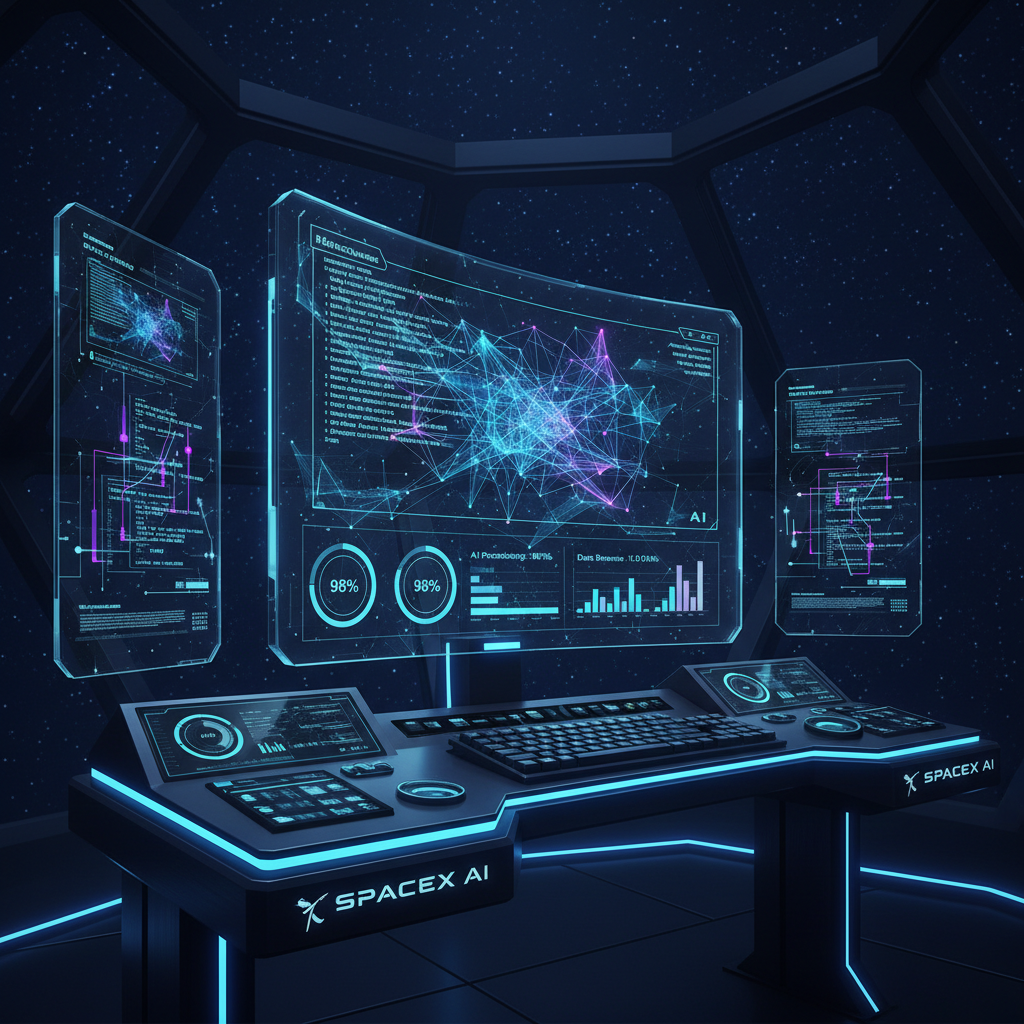
In recent weeks it seems the AI market has reached a certain saturation of announcements, but the new collaboration between SpaceX and Cursor is not just another press release. It is an event that shuffles the deck when it comes to computing infrastructure (Compute) and the future of software writing. When one of the world's most advanced engineering companies teams up with the fastest-growing development environment (IDE) today, the goal is clear: to create the most powerful AI ever built for writing code.
Computing Power at the Scale of a Superpower
The core of this collaboration rests on one almost unimaginable figure: SpaceX's supercomputer. According to reports, the system has processing power equivalent to a million NVIDIA H100 chips. To put it in perspective, most computing Clusters at the big tech companies today are measured in tens of thousands of individual chips.
What do you do with such power? When this capability is connected to Cursor, the goal is not just to "complete sentences" in code. The goal is to let the model understand projects of millions of lines of code at once, run real-time optimizations that no human can spot, and solve complex architectural bugs in critical systems.
Why Cursor?
For those who have not followed, Cursor has become the new standard among developers in recent months, overtaking GitHub Copilot in its ability to understand the "Context" of the whole project. It is based on VS Code, but with a deep AI layer that lets developers talk to their code, ask for sweeping changes, and build entire features with a single command.
For SpaceX, depending on reliable software is a matter of life and death (or, in their case, of launch success). The ability to embed their computing power directly into the engineers' work environment will let them accelerate the development of the control systems of Starship and of the Starlink satellite network at rates we have not seen before.
The Financials: A $60 Billion Bet
The most astonishing detail in the deal is its financial structure. SpaceX received an option to acquire Cursor at a valuation of $60 billion by the end of the year. This is a sum that reflects huge confidence in the technology, especially for a company that is still at a relatively early stage of growth.
Alternatively, if the acquisition does not go through, SpaceX will pay $10 billion for the joint work alone. These amounts show that this is not a cosmetic improvement of the IDE, but an attempt to build an engineering "brain" that can replace large parts of the traditional development process.
What Does This Mean for the Future of Development?
The combination of extreme hardware (H100) and smart software (Cursor) brings us to a turning point:
- •Autonomous code: We are approaching a situation where the developer acts more as a system designer (Architect) and less as a technician typing syntax. The models trained on SpaceX's supercomputer will be able to produce code more efficient than humans' in terms of memory use and runtime speed.
- •Infinite context: The biggest problem of AI today is short-term memory (Context Window). With this much processing power, those limits are expected to disappear, which will let the AI manage huge software systems without forgetting functions written at the other end of the system.
- •The Compute arms race: This deal highlights that in the AI world, access to hardware is king. Companies that do not hold massive processing power will struggle to compete on the quality of the models they offer developers.
Summary and Conclusions
The alliance between SpaceX and Cursor is a clear signal to the industry: your next tool will not be just a text editor with autocomplete, but a full engineering partner backed by the computing power of a small country.
For developers, the conclusion is simple: whoever does not learn to work with tools like Cursor now will find themselves behind when these tools become 1,000 times stronger under SpaceX's umbrella. We are moving from an era of "writing code" to an era of "managing intelligence," and the speed at which this is happening is simply dizzying.
For more information about the technologies: