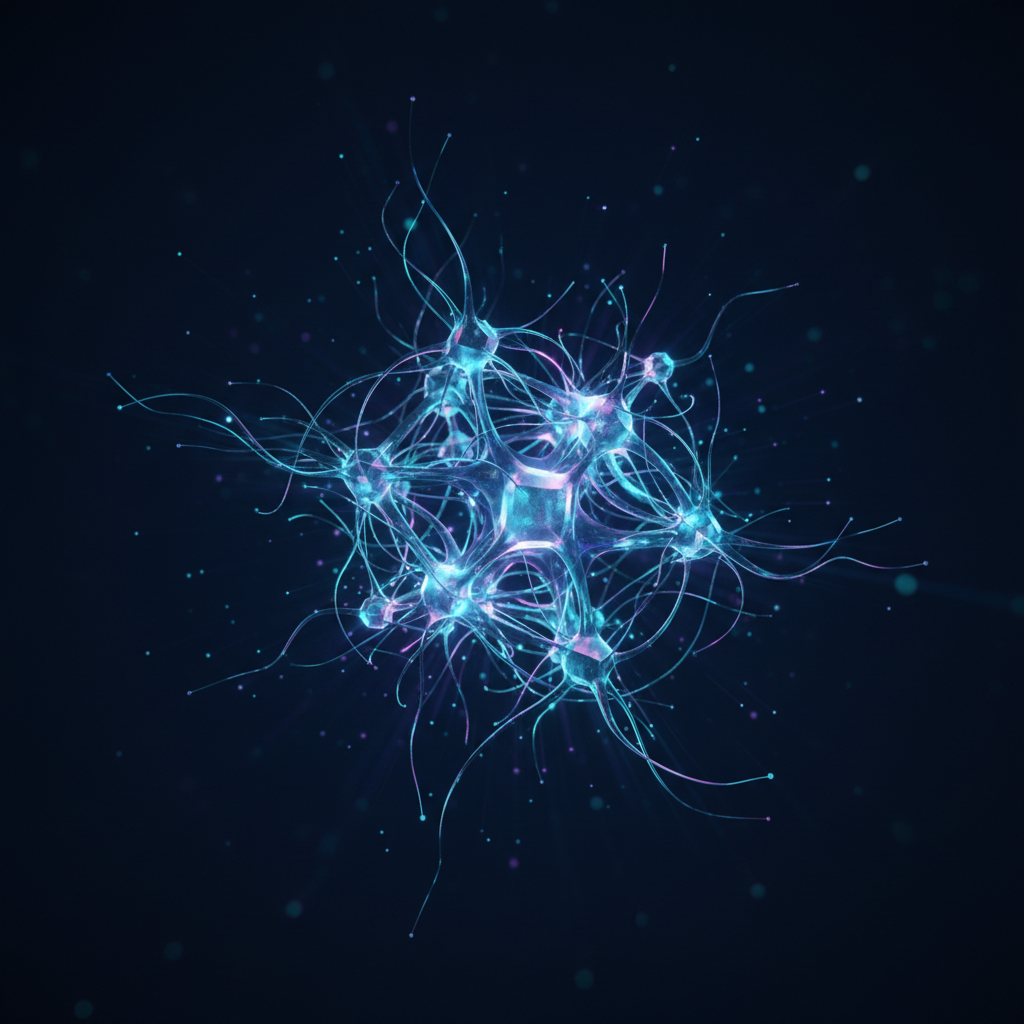
How Google Saves 150 Years of Human Work with "Fake" Neurons
Mapping the human brain is perhaps the greatest technological and scientific challenge of our time. To understand how the brain works, we need to map not only the cells themselves but the tangled network of connections between them – a field called Connectomics. The problem? The brain is huge, and the details are tiny. Scanning a piece of brain the size of a grain of rice generates about 1.4 petabytes of data.
Until now, the main bottleneck was not computing but the human factor. Now, researchers at Google Research have presented a significant breakthrough called MoGen, which may change the rules of the game in computational biology.
The Problem: When Even AI Needs a "Babysitter"
To map a brain, researchers use an electron microscope to image extremely thin slices of tissue. Artificial intelligence algorithms (such as Flood-filling networks) go through these images and try to reconstruct the 3D shape of every single neuron.
The problem is that these algorithms are not perfect. They tend to make "merge" errors (joining two separate neurons) or "split" errors (cutting one neuron into two). For the map to be accurate enough for scientific research, humans have to sit in front of the screen and fix these errors by hand. It is Sisyphean, slow and terribly expensive work.
The Solution: MoGen – a Generative Model for Synthetic Neurons
Instead of sending more humans to fix errors, Google developed MoGen (short for Morphology Generator). It is a generative AI model based on Point Cloud Flow Matching technology. Instead of generating pictures of cats or marketing copy, MoGen generates 3D structures of synthetic neurons.
These neurons are "fake," but they look and behave exactly like the real thing – including the twists, curves and complex branches of axons and dendrites. In an experiment run by Google, human experts could not tell the difference between a real neuron and one generated by MoGen.
Why does this matter? Because now it is possible to generate millions of examples of neurons and use them to train the recognition systems (the Classifiers). The more examples of "what a neuron should look like" the system sees, the better it gets at detecting errors in real time.
The Math of the Savings: 4.4% Worth 157 Years
Using MoGen's synthetic data improved reconstruction accuracy by 4.4%. On the face of it, that sounds like a negligible improvement, but when you look at the scale of a whole brain, the numbers become astonishing:
- •In a mouse brain: This improvement translates into a saving of 157 years of work by a human expert.
- •In a human brain: It is a saving of thousands of years of work, which makes projects that were considered impossible feasible both economically and technically.
The new model was presented at ICLR 2026 and is now available as Open Source, which lets the entire scientific community use it to accelerate research on diseases such as Alzheimer's and dementia.
Bottom Line: The AI That Trains Itself
The MoGen project is a great example of a broader trend in the tech world: using Synthetic Data to overcome a shortage of data labeled by humans. As these models improve, we will see AI solving more complex problems in science, not only by processing existing data, but by creating entire worlds of content that serve as a simulation for learning.
If you want to dive into the technical details, Google has released the full paper and the code:
- •The MoGen scientific paper on OpenReview
- •Google Research's overview of the connectomics project
- •A look at the interactive brain maps from Google and Harvard
Our ability to understand the most complex machine in the universe – our brain – is about to take a leap thanks to the combination of 3D geometry and generative AI. This is no longer just science fiction, but data engineering at its best.