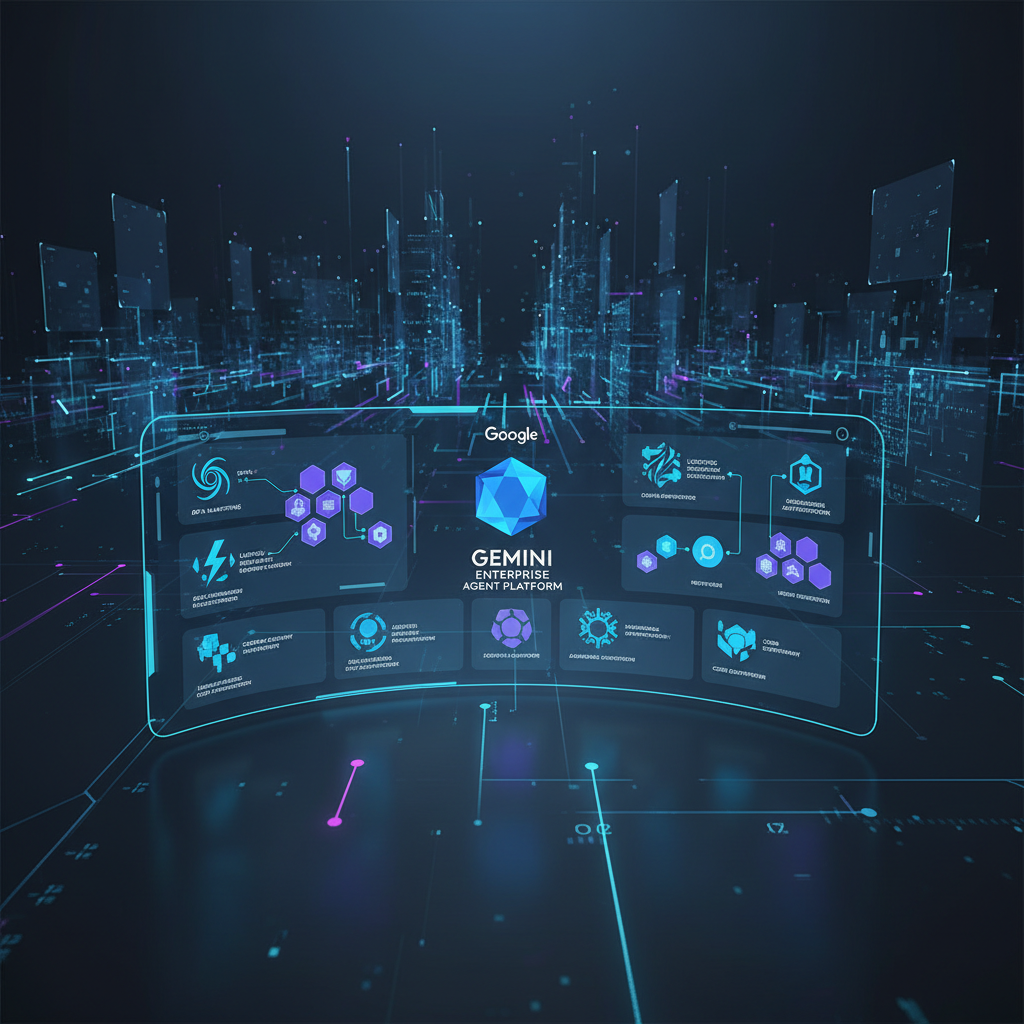
Beyond Words: Google Announces the Gemini Enterprise Agent Platform, Turning AI into an Active Team Member
Instead of answering questions, Google's AI is starting to perform complex, multi-day tasks. This is the true revolution unveiled at Cloud Next '26.
Until now, our interaction with Generative AI was primarily centered around conversation. We asked questions, received answers, or perhaps requested a document summary. But at Google Cloud Next '26, Google made it clear that this phase is over. The bottom line of the conference is simple: we are moving from the era of chatbots to the era of agents.
This is not a cosmetic improvement, but a true paradigm shift. If until now AI was an auxiliary tool sitting on your desktop, Google wants it to be an independent team member that performs work end-to-end, with minimal human intervention.
Meet the Gemini Enterprise Agent Platform
The most significant announcement is the launch of the Gemini Enterprise Agent Platform. This is effectively the evolution of Vertex AI, transforming from a model development platform into a complete operating system for enterprise AI agents.
The innovation here is the ability to build agents that not only "think" but also "act." The platform allows organizations to define agents with the capability to run in the background for extended periods (Long-running agents). The implication? An agent can take on a complex task—like managing a procurement process with ten different suppliers—and execute it autonomously for days, without you needing to keep a browser window open.
Approving tasks like in your email inbox
One of the biggest challenges in adopting autonomous agents is the loss of control. How will we know what the agent did? How do we ensure it didn't exceed its authority?
To solve this, Google introduced the Agent Inbox. This is a control center that looks and feels like an email inbox, but instead of emails, it centralizes all the actions of the agents in the organization. Here you can see a log of every action, receive alerts when the agent needs help, and most importantly—approve sensitive actions. This is the "Human-in-the-loop" mechanism that allows an organization to scale without sacrificing control and security.
Agents talking to agents: A2A protocol
Another fascinating aspect is Agent-to-Agent Orchestration. Google has implemented support for the A2A protocol, which allows different specialized agents to collaborate.
For example: A marketing agent can contact a data analysis agent to get insights on a campaign, and then send an instruction to a media agent to update the budget. This process happens without human mediation, enabling the execution of multi-step tasks at unprecedented speed.
To make this an industry standard, Google has adopted the Model Context Protocol (MCP), which allows agents to easily and securely connect to organizational data sources like BigQuery or Salesforce in a managed way.
The infrastructure behind the scenes: TPU 8
To run an army of such agents, massive computing power is required. Google unveiled the eighth generation of its TPU processors, with a clear division:
- •TPU 8t: Optimized for model training, with 3 times more processing power than the previous generation.
- •TPU 8i: Optimized for inference, designed to enable the simultaneous running of millions of agents with near-zero latency.
These chips form the backbone of Google's "AI Hypercomputer," ensuring that the running costs of such agents will not be a barrier for small and medium-sized businesses.
Summary and conclusions
We are at a turning point where artificial intelligence stops being just "smart" and starts being truly "useful." The shift to agents takes administrative and tedious tasks off employees' shoulders, allowing them to become managers of AI-entity teams.
For technology leaders and developers, Google's message at Cloud Next '26 is unequivocal: Don't build another chatbot. Build an agent that knows how to perform work, connect to enterprise systems, and operate under clear corporate governance.
Want to dive deeper into the technical details? Here are some relevant links: